

Artificial Intelligence (AI) is the hottest topic in the tech industry right now. But we are paying less attention to the infrastructure on which AI’s knowledge base is running.
The more rapidly a country advances in technology, the more attention it has to pay to data storage and processing. And the most reliable physical infrastructure is a data center.
As a data centre equipment manufacturer, you have an open strategic opportunity: to venture into the most favourable countries and scale globally.
You want an import destination that delivers the best return on your investment. And the smartest step you can take is to identify a destination with less red tape, government support for foreign investors, and a high demand for imported data centre equipment.
However, determining the best import destination for your hardware can be a hurdle. And you may lack the time to conduct a feasibility analysis of essential factors such as market access, changing tax and duty rates, and the regulatory requirements.
Not to worry, Blackthorne IT did the heavy lifting for you. Drawing on our global expertise, we researched, analysed, and ranked the top five import destinations to consider for your next data center deployment.
These are countries you can easily access, transport, and install your equipment without breaking the bank, and meet all import requirements seamlessly.
Now, let’s head straight to our top five IOR-friendly countries.
We ranked the IOR-friendly countries based on three critical factors: regulatory complexity, ease of market access, and reliance on data centre equipment imports.
Here are the top five most favourable import destinations for your data centre equipment and why you should consider them:
The Australian data centre market was valued at USD 4.22 billion in 2025. It is projected to reach USD 9.02 billion by 2031, growing at a 13.52% CAGR over the forecast period.
Various projects are accelerating the market growth, including the multi-year cloud migration project, which involves upgrading the IT infrastructure and moving outdated systems to the cloud.
The rapid adoption of AI and the expanding hyperscale cloud are also increasing demand for advanced compute devices, creating an opportunity for technology providers.
Here is a quick look at Australia’s data centre market analysis.
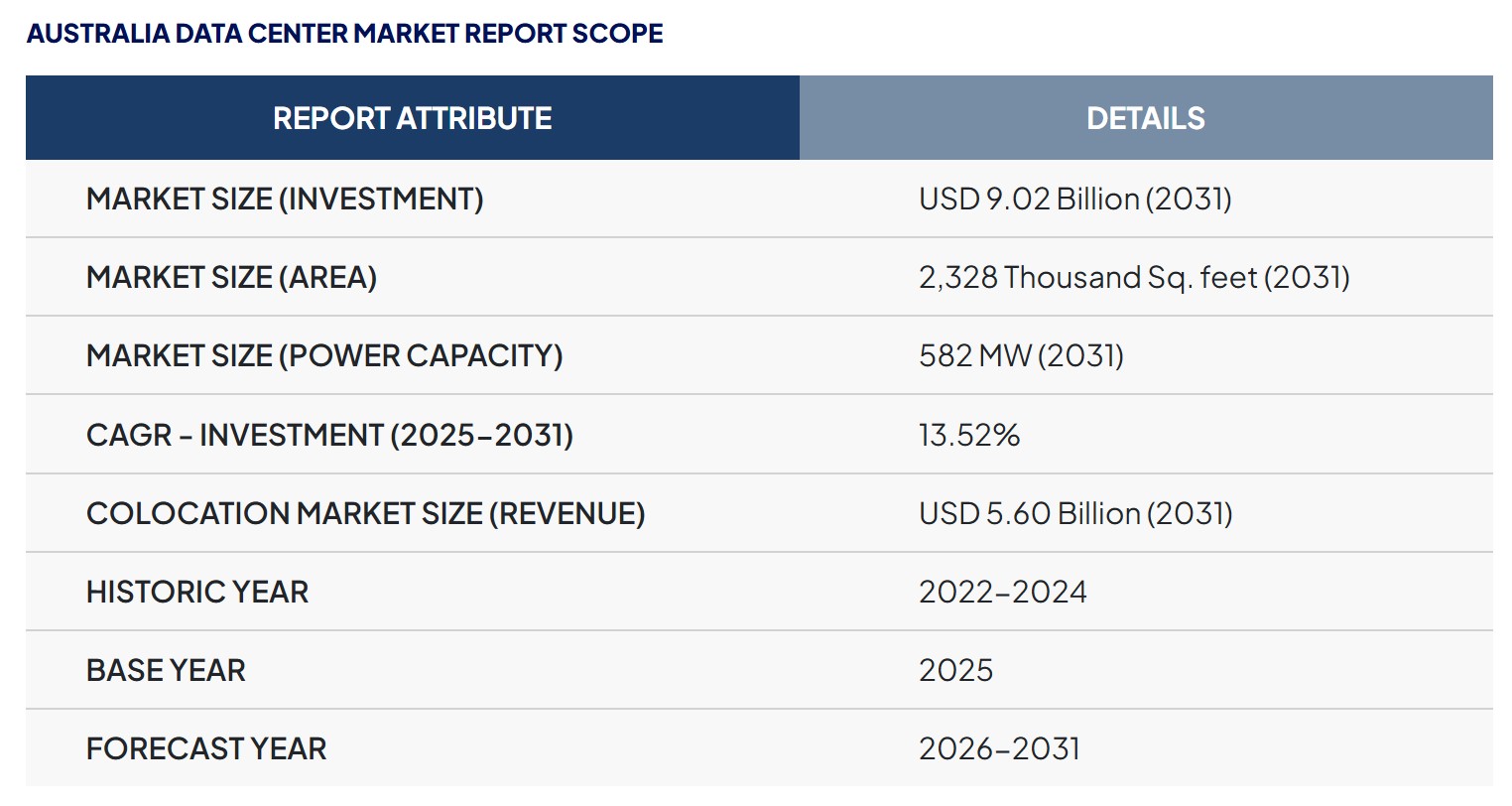
Image source: Australia Data Centre Market Analysis
But does Australia invite foreign investors to venture into this fastest-growing market?
Machinery and electrical equipment are amongst Australia’s leading imports. In March 2026, the country experienced a 322% surge in imports of automatic data processing (ADP) equipment from Taiwan alone.
ADP equipment includes chips, servers, and compute infrastructure used in data centres. These were imported following increasing investment in data centre infrastructure and hyperscale computing capacity.
This sustained import dependency creates an opportunity for global manufacturers and suppliers of data centre infrastructure equipment.
The key regulatory requirements for importing data centre equipment into Australia include:
Let’s look at Australia’s duty rates, infrastructure, and how the government supports foreign investors:
Duties and Taxes
The country maintains a relatively predictable tax structure for technology equipment:
Infrastructure
Australia’s infrastructure supports data centre equipment importation through:
Government Support
Here are the various ways the Australian government supports foreign investors:
The UAE data centre market was valued at USD 1.48 billion in 2025. It’s projected to hit USD 3.86 billion in 2031, growing at a 17.33% CAGR through the forecast period.
The UAE is investing heavily in AI infrastructure, cloud services, and smart cities, which explains the rapid market growth. Dubai and Abu Dhabi are attracting hyperscale operators and colocation providers seeking to serve the MENA region.
Additionally, the government is establishing initiatives that encourage technology adoption and foreign investments.
Here’s a visual projection of the market growth between 2026 and 2031:
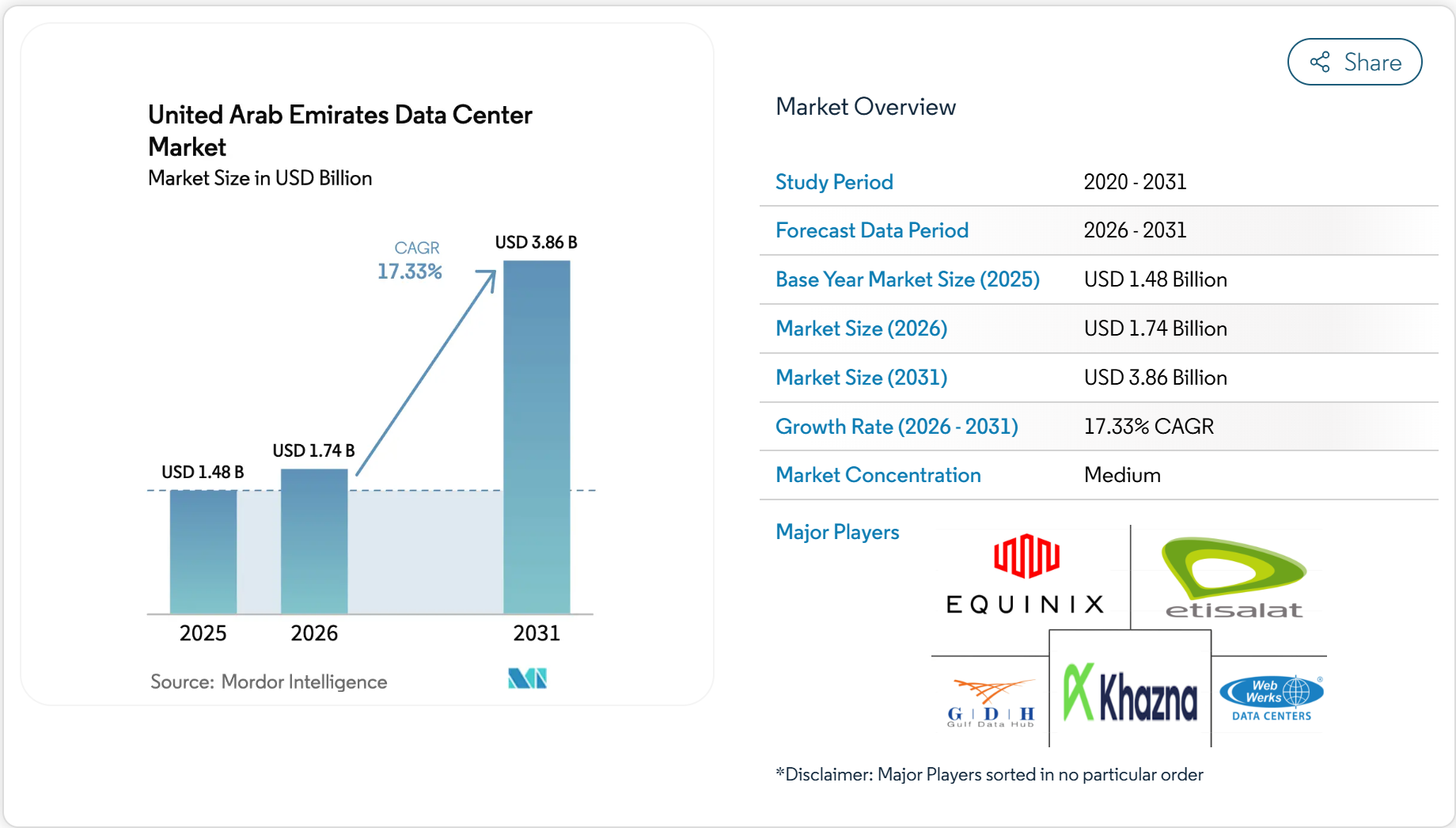
Image source: United Arab Emirates Data Centre Market Size and Share
But how favourable is the growing market for foreign investors?
The UAE has limited production of servers, networking equipment, and advanced server systems. And that explains why machinery and mechanical appliances, and electrical machinery and equipment are amongst the leading imports into the UAE.
The country sources most IT equipment from the United States, Taiwan, China, and European suppliers.
The key requirements for importing data centre equipment into the UAE include:
You can dive deeper into the detailed Telecom and ICT equipment import requirements in the UAE guide.
Here are the various ways the UAE facilitates market entry for foreign importers:
Duties and Taxes
Import duties are relatively low, entailing:
Infrastructure
Various developments in the UAE support secure transportation and installation of data centre equipment:
Government support
The UAE supports foreign investors in the following ways:
The UK data centre market size was priced at USD 16.30 billion in 2025. It is projected to reach USD 54.40 billion by 2031, growing at a 22.12% CAGR over the forecast period.
Here’s the market growth projection at a glance:
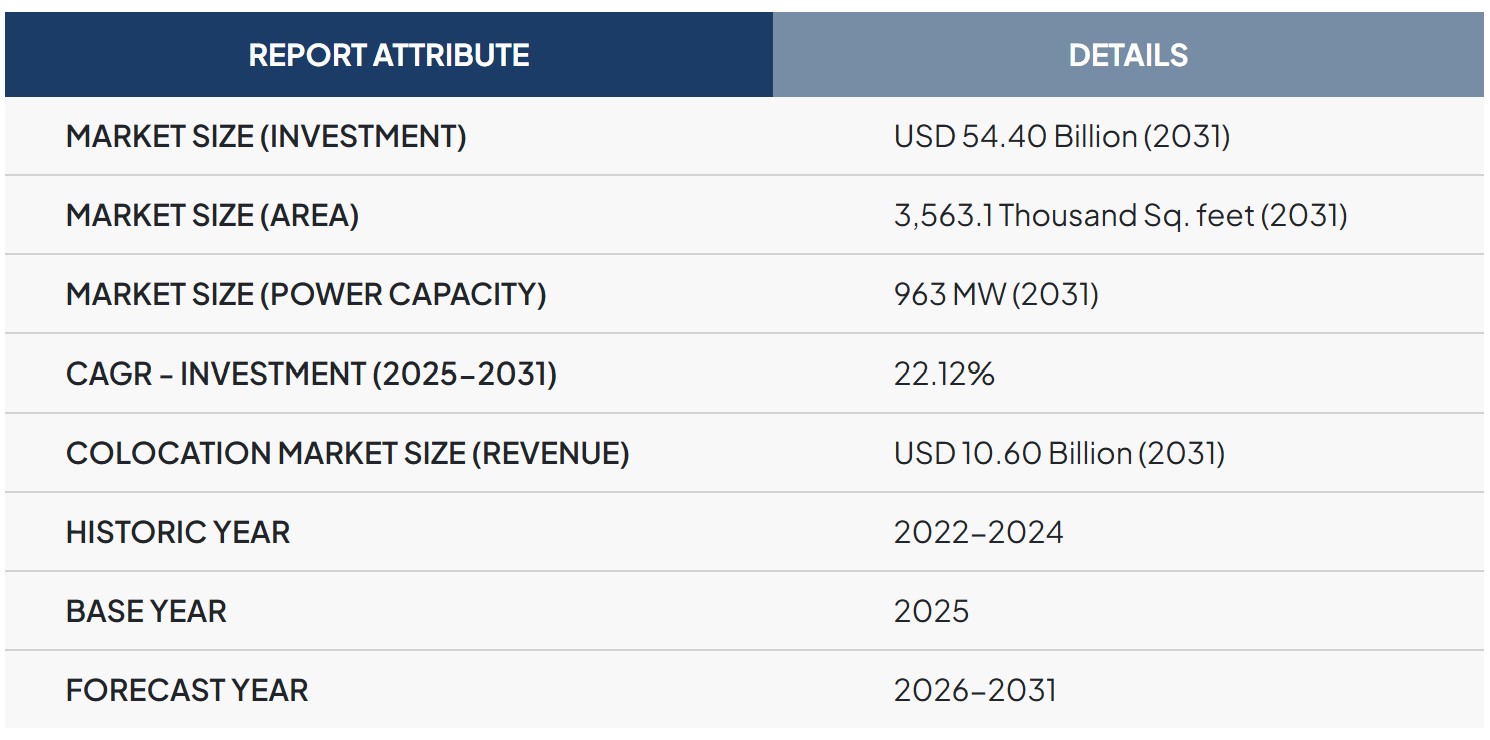
Image source: UK Data Centre Market Investment Analysis
The projected growth is over three times the current size. But what are the key drivers of the soaring growth?
Global and local data centre companies are establishing their operations in the UK due to a surge in:
Also, the UK government is accelerating AI infrastructure deployments across the country with financial incentives and funding ventures for data centre operators.
That already feels like the ideal destination for your data centre deployments.
But does the UK rely on imported equipment? And how easy is it to access the market, especially for foreign investors?
In 2025, electrical machinery, machinery, and equipment were among the leading imports into the UK.
Amongst the imports is data centre equipment, whose spending is projected to increase up to ten times by 2030.
This creates an opportunity for overseas technology manufacturers to supply equipment into the UK, Europe’s fastest-growing AI and cloud markets.
The key requirements for importing data centre equipment into the UK include:
A closer look into the duties and taxes, logistics infrastructure, and government support for foreign investors reveals:
Duties and taxes
Duties and taxes include:
Infrastructure
The UK’s infrastructure is well developed, entailing:
Government support
The UK government supports foreign investors in various ways, including:
Singapore’s data centre market was estimated to be USD 4,275.05 million in 2025. The market is projected to hit USD 13,330.27 million by 2035, growing at a 11.96% CAGR throughout the forecast period.
But what drives such insane growth?
Singapore is experiencing growing demand for data, with enterprises embracing automation, AI, and energy-efficient solutions to meet it. Such demand plays a key role in market growth, creating an opportunity for investors in advanced technology.
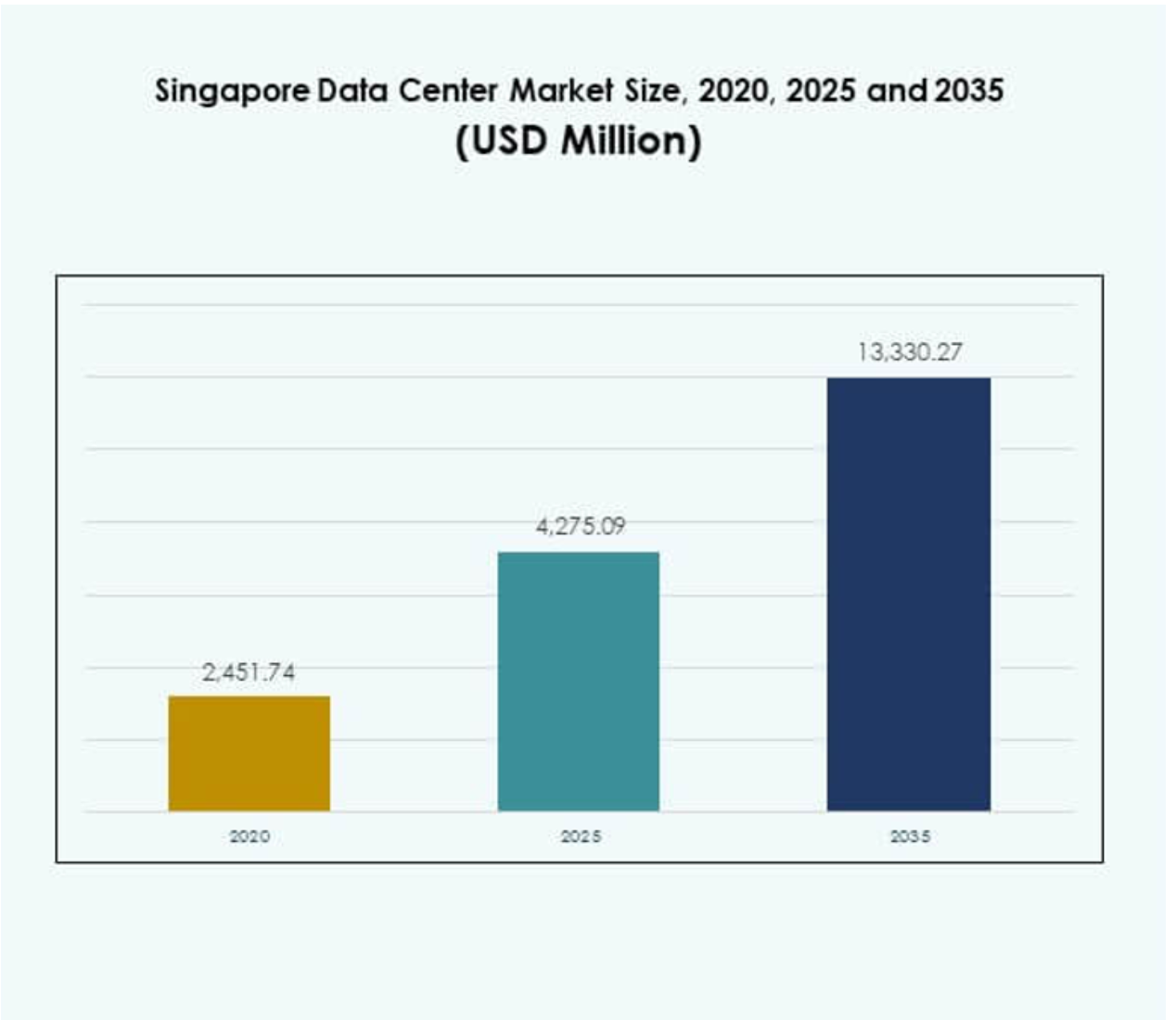
Image source: Singapore Data Centre Market by Component
Singapore doesn’t manufacture servers, networking hardware, or cooling systems locally. However, it imports best-in-class equipment from global suppliers for deployment in world-class facilities.
Machinery and equipment, including data centre equipment, accounted for 43% of Singapore’s total imports as of March 2026. This reliance on imported technology creates an opportunity for foreign tech manufacturers to enter the rapidly growing market.
Singapore’s IT equipment import requirements and procedures are well structured and predictable:
Singapore’s customs procedures, advanced logistics infrastructure, and government support for foreign investments simplify market access:
Duties and Taxes
Singapore’s free-port status offers a competitive value proposition:
Infrastructure
Singapore’s logistics infrastructure is world-class:
Government Support
Singapore’s government offers various incentives to support foreign investments:
The Netherlands data centre market was estimated at USD 11.25 billion in 2025. It’s projected to reach USD 18.96 billion by 2031, growing at a 9.1% CAGR over the forecast period.
The colocation segment alone is expanding at 17.5% annually, a pointer to a wide-open door for both local and foreign investors.
Here is a visual representation of the projected market:
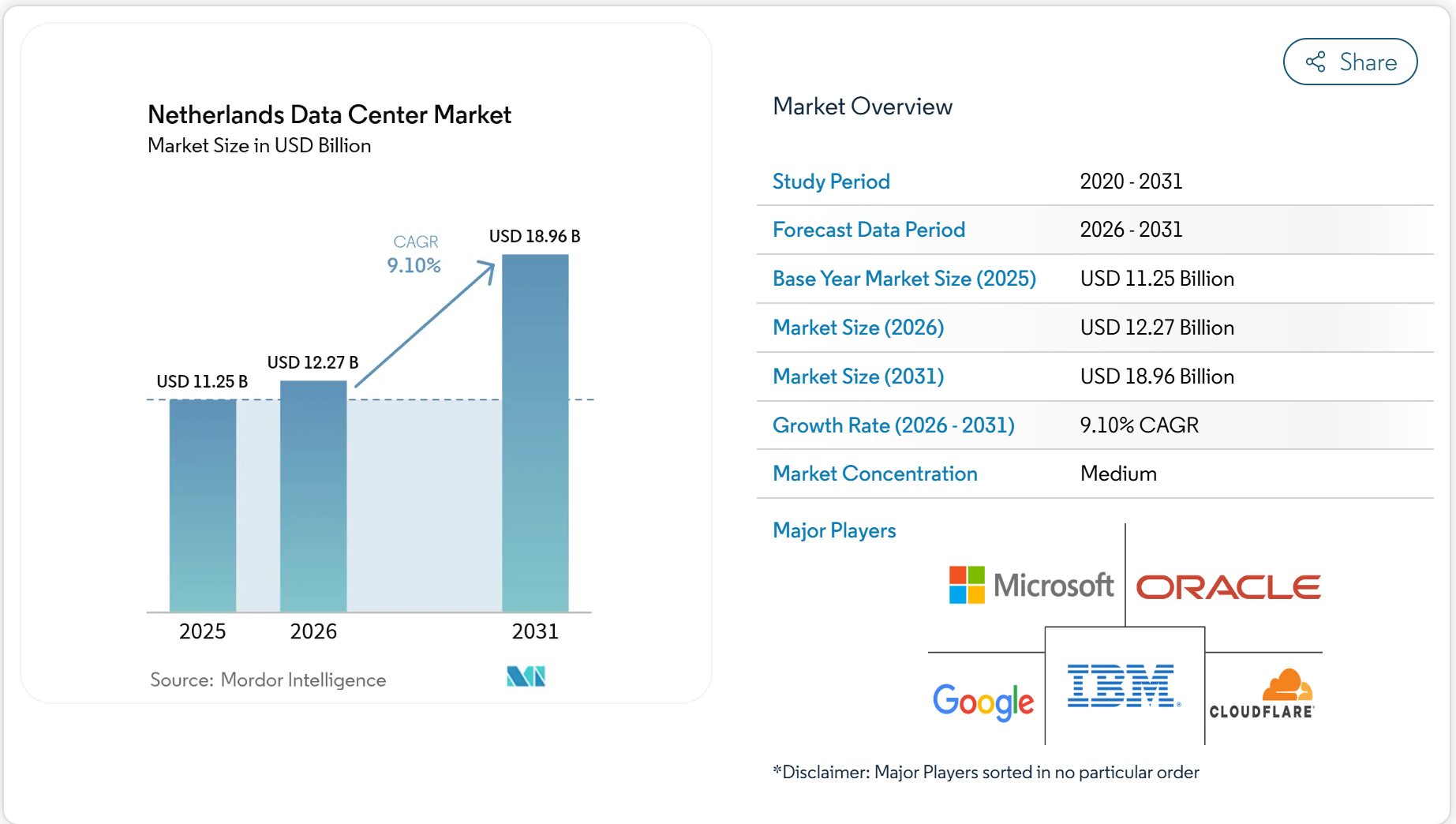
Image source: Netherlands Data Centre Market Size Industry Report
Let’s look at the key drivers for the market growth:
The Netherlands is experiencing a surging demand for high-density cooling and electrical systems. This demand stems from rapid, large-scale expansions by Google, Microsoft, and Oracle.
The country is also commercially scaling the adoption of liquid and immersion cooling to maximise rack density and reduce floor space requirements within real-estate-confined regions like Amsterdam.
The goal is to increase GPU stability to accommodate rising rack density demand from research institutions and hyperscalers. Plus, the government is also creating more space in selected secondary cities for advanced AI training and tech developments.
But how favourable is this hyperscale-dominated market for SMEs and medium-sized foreign investors?
Let’s dive into the import dependency, regulatory requirements, and market accessibility.
Electrical machinery and equipment, including data centre equipment, tops the list of the Netherlands’ imports.
The country imports the vast majority of servers, networking hardware, and other components from Taiwan, China, the United States, and Eastern Europe.
Essentially, hyperscalers cannot meet the rapidly increasing demand for data centre equipment. Instead, they create a competitive advantage as data centre operators source advanced technology from global manufacturers to meet the demand.
Also, the Netherlands serves as a distribution centre for the wider European Union market. That opens an additional opportunity for manufacturers seeking to use the country as a strategic entry point to Europe’s digital infrastructure.
Data centre equipment entering Europe must comply with Dutch and European regulations regarding:
The key IT equipment requirements and regulations in the Netherlands include:
Meeting the regulatory requirements may be complex for new importers. However, once your equipment meets the EU standards, it gains unrestricted entry to the European Economic Area.
Here is an overview of how duty rates, logistics infrastructure, and the Netherlands’ government ease market entry for foreign investors:
Duties and Taxes
Imported data centre equipment is subject to import duties and VAT:
Infrastructure
The Netherlands infrastructure is one of the most advanced in Europe, supporting high-value technology imports:
Government Support
The Dutch government supports various investors in various ways:
We have done an in-depth feasibility analysis of the top five most favourable import destinations for your data centre equipment.
Generally, these are countries hand-picked because they’re easily accessible, rapidly growing, and favourable for foreign investors.
Here’s a summary report you can refer to when choosing a preferred destination, with the key advantage for each of the five destinations:
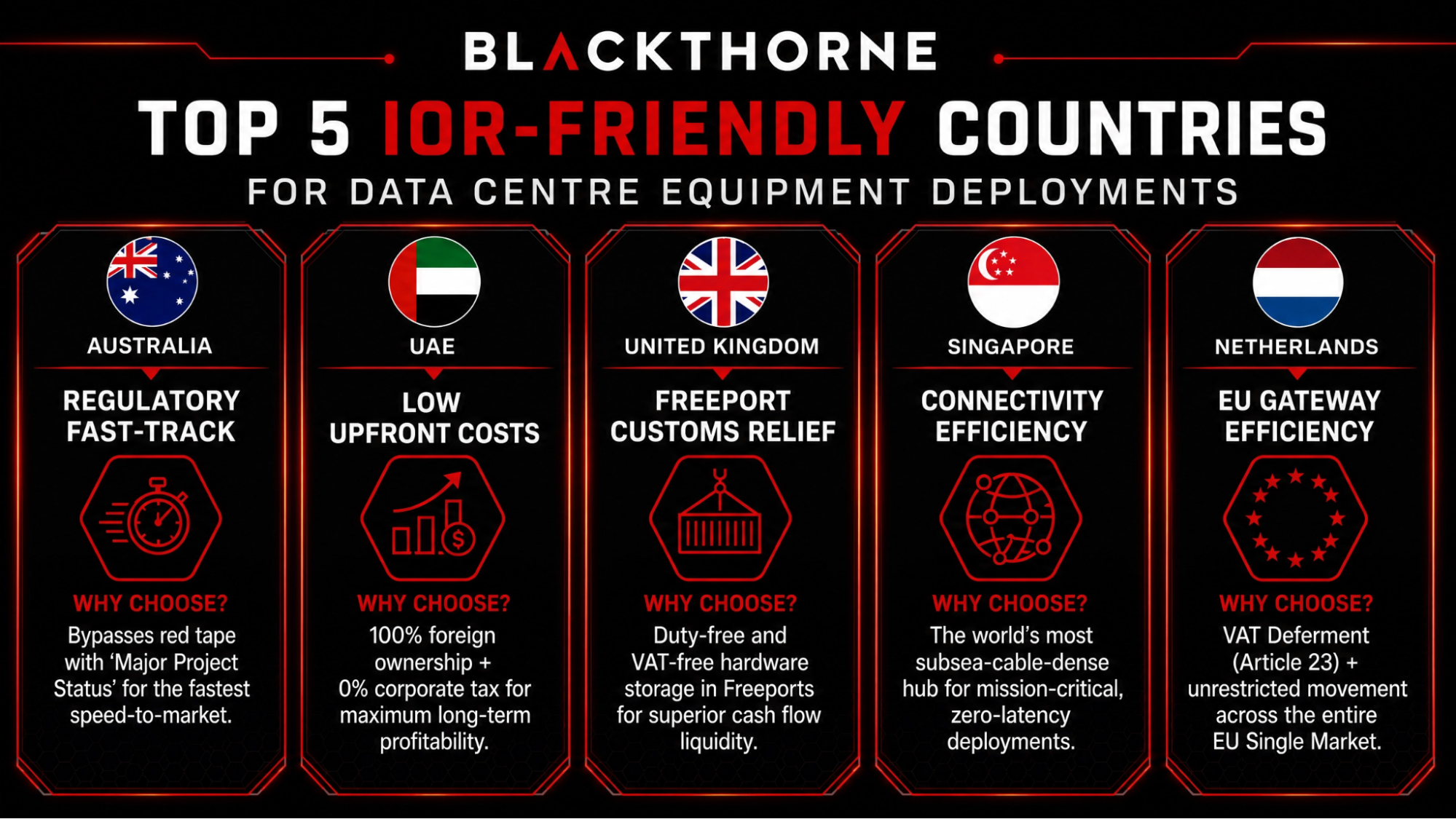
Notably, data centre equipment is subject to technical requirements, including licensing, certification, and approval from relevant departments in every destination. These procedures can be straightforward, yet complex to carry out.
Hence, you may consider a third-party importer of record specialising in IT equipment compliance, such as Blackthorne IOR, for a seamless customs clearance.
That way, the IOR can use its accreditations and expertise to expedite the technical evaluation procedures.
Business needs vary. And the best import destination today may be the worst tomorrow due to economic shifts, regulatory changes, and uncertain circumstances such as wars and natural calamities.
Beyond the logistics infrastructure and market demand, here are the three key factors to consider when choosing an import destination for your equipment:
The demand may be high, but the country prioritises local manufacturers. In such cases, the government may limit unfair competition in three main ways:
Hence, you must evaluate how your import destination supports foreign investments before settling with it as your destination.
Meeting the technical requirements for importing data centre equipment is non-negotiable. But you want to understand how structured and predictable those requirements are.
You don’t want to import your equipment today, only to have a list of procedures to fulfill next month. That points towards choosing a stable market over a growing one.
While the developing market may be potentially more profitable, it can be costly to keep up with changing trade policies, compliance procedures, and long-term predictability.
Therefore, consider:
The cost of your data centre equipment spans its entire operational cycle. A financial evaluation across these three areas would be essential:
There you have it. Five best destinations to choose from when scaling your data centre deployments, and an expert evaluation criteria of your next import destination.
Clearly, meeting the regulatory requirements for data centre equipment requires a dedicated compliance expert. This is because meeting the technical requirements, approvals, and certifications can be time-consuming and costly.
Additionally, depending on your country of origin, you may be unsure which destination best serves your business needs without setting up a local entity.
These are gaps Blackthorne IOR has been keen to fill in the following ways:
We have a technical team in the various import destinations where we are already established to offer equipment support and maintenance. Plus, we also do virtual IT support.
What else do you need?
We are invested in the secure and compliant movement of IT equipment across the globe at the lowest possible costs.
Our line is active, so you can call at your convenience, or email us at sales@blackthorneit.com to start planning your next data centre deployments.
