
Accurate classification of imported goods under the Harmonised System (HS) is imperative in the import-export process. It directly influences duties, taxes, and the customs clearance procedure.
Most countries have adopted the standard 6-digit base code to ensure global uniformity in product classification. However, some countries and regions extend these codes beyond the 6th digit for more specific tariffs and regulations.
Such structural differences create classification challenges for importers operating across multiple markets. And incorrect classification can result in underpayment or overpayment of duties and taxes, shipment delays, and financial penalties.
Hence, as an importer, you need an in-depth understanding of the customs classification codes and country-specific tariff extensions to avoid noncompliance.
In this article, Blackthorne delves into the customs classification codes, explaining what they are, their role, and best practices for accurate classification.
Let’s dive in!
Customs classification codes are globally recognised numerical identifiers used to classify goods in international trade.
The Harmonised Commodity Description and Coding System, commonly known as the Harmonised System (HS), is the universal standard for classifying internationally traded goods.
The six-digit HS code was developed by the World Customs Organization (WCO), covering over 5000 logically structured commodity groups. More than 200 countries use the system to classify goods and determine applicable tariffs and taxes.
The HS System is updated every five years to reflect technological and industrial changes, ensuring new products are accurately categorised.
At the international level, HS codes entail six-digit numbers, organised into chapters, headings, and subheadings. According to the WCO’s latest HS edition, there are 96 chapters, over 1200 headings, and over 5000 subheadings.
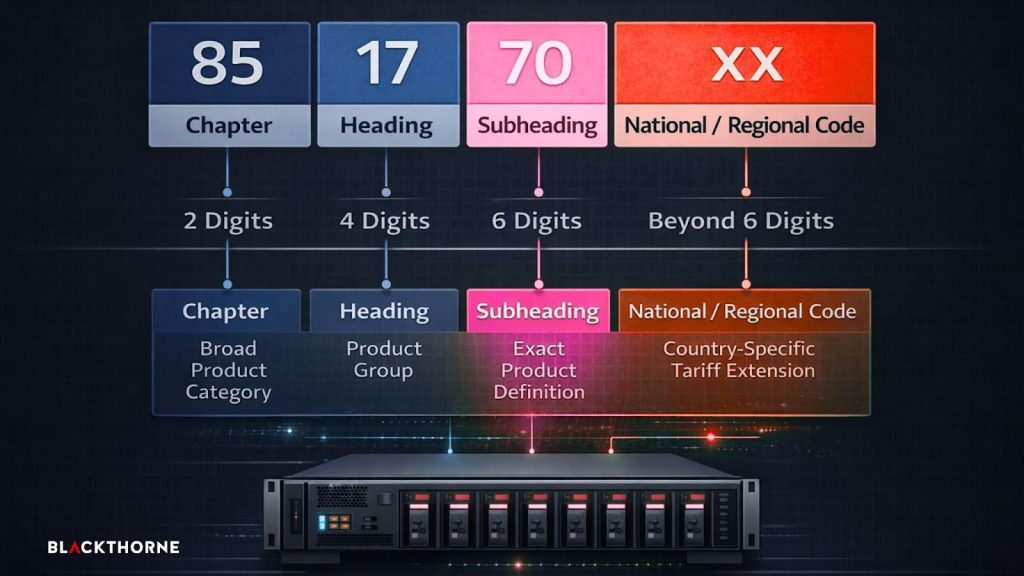
For a better understanding of the structure, let’s break down the HS code into its three main components:
Chapter
The first two digits of the HS code represent the chapter. They define the broad industry category of the product, narrowing the classification to a specific group.
For instance, most IT and data center equipment falls under either chapter 84 or chapter 85. Chapter 85, shown in the image below, includes electrical equipment, machinery, and parts.
Headings
Within each chapter, the heading (the first four digits) narrows the classification to a specific group of related products. Based on the Chapter 85 example, Heading 8517 focuses on devices used to transmit or receive images, voice, or data.
Such devices include telephones, routers, and network servers. The heading helps customs officials and traders to identify the functional group to which a product belongs.
Subheadings
Represented by the first six digits, distinguishes between different types of products within the same heading.
Under Heading 8517, for example, subheading 8517.70 refers to parts and accessories for telephone sets and other appliances for data transmission or reception. Such items include data storage units, network servers, aerials, switches, and gateways.
The country-specific tariff extensions differ from country to country. But that offers no excuse for misclassification.
Accurate classification is significant in the following ways:
So, how do you determine the chapter, heading, and subheading of different items when importing for accurate classification?
Here is a step-by-step guide to classifying goods accurately:
A thorough understanding of the product you are importing is the basis for customs classification. This includes understanding its composition, function, and how it operates.
Many modern products perform multiple functions. An accurate HS code relies heavily on the products’ primary functionality.
For instance, a multi-function printer that can print, fax, and scan is classified under the printers heading, as printing is its primary function.
The WCO publishes the HS Nomenclature, which lists all sections, chapters, headings, and subheadings. Each section entails explanatory notes that describe the scope of each category. These notes can help decide the correct classification.
The WCO’s General Rules for Interpretation (GRI) provide a standardised method for classifying goods.
There are six hs code classification rules that guide the classification process. With the GRI, you can choose the correct heading and subheading based on characteristics, composition, and intended use.
Once you identify the six-digit HS code, it’s essential that you consult the national tariff schedule of the importing or exporting country. That way, you will be able to apply any additional digits or national distinctions.
While the classification procedure is straightforward, there are various challenges to overcome when determining HS codes.
Here are the five main challenges and the best practices to overcome them:
Without the technical expertise of the product you are classifying, it’s challenging to determine the exact chapter, heading, and subheading. This includes knowing a product’s composition, functionalities, and intended use.
For instance, distinguishing between a server, a network appliance, and a storage unit requires familiarity with how each device functions and interacts within a system.
Collaboration of the technical team, product engineers, and compliance experts is essential in determining HS codes. Additionally, you can select the right importer of record for your industry to handle product classification on your behalf.
Manufacturers and suppliers often use marketing-driven terminology that may not align with customs descriptions.
Terms such as smart system, electronic equipment, and network appliance may be fit on a commercial invoice, yet be insufficient for customs purposes. An accurate customs classification relies on information such as:
To ensure compliance, consider standardising product descriptions in an internal classification database.
The national tariff extensions differ from one country to another. Customs authorities may also issue binding rulings that interpret certain subheadings differently based on local regulations or trade policy.
This lack of uniformity creates compliance issues, especially if you are shipping the same product to multiple destinations. A classification that is valid in one country may not be accepted in another.
To cope with the national differences, ensure you keep a matrix that maps HS codes across key markets. You can also consider consulting local customs brokers or IOR experts like Blackthorne in each import destination.
Rapid technological advancements, especially in sectors such as telecommunications, information technology, and electronics, challenge the HS system’s ability to keep pace.
New products may not fit within existing HS categories. For instance, devices such as cloud servers and IoT gateways may perform computing, communication, and control functions simultaneously.
In such cases, determining the primary function for HS classification can be complex.
Additionally, emerging technologies such as quantum computing and edge infrastructure may lack dedicated HS codes. This limits importers to relying on interpretive rulings or temporary classifications.
As an importer, you must stay ahead of HS code updates and proactively review classifications to ensure continued compliance.
The periodic revision of the HS system entails adding new codes, redefining descriptions, or introducing new subheadings. Failure to keep pace with such updates risks using obsolete HS codes, which may lead to noncompliance.
To stay ahead of updates, you must train your compliance team regularly and coordinate with freight forwarders, customs officials, and customs brokers.
You can automate customs classification updates via software integration, regulatory subscriptions, or sms alerts.
Structured practices that align with international standards and national customs requirements are key when classifying goods for international trade.
Here are the six main best practices you can adopt to ensure accuracy, consistency, and compliance:
Maintaining detailed documentation ensures you have verifiable data to support the choice of specific classification codes.
Such documents include technical datasheets, engineering drawings, product manuals, user guides, bills of material, and certificates of conformity.
For IT and data centre equipment, technical specifications, power rating, storage capacity, and intended use are key features in product documentation.
The World Customs Organization’s Explanatory Notes provide detailed explanations, clarifications, and examples for each heading and subheading. This helps importers understand the scope and intent of every classification.
The General Rules of Interpretation (GRI) govern the choice of headings, subheadings, and chapters when classifying goods.
With the GRI, you are guided on classifying goods that:
In cases of uncertainty when classifying a product destined for the US, you can obtain an advance ruling from a customs authority.
A binding ruling is an official decision that the US Customs and Border Protection (CBP) issues upon request for goods entering the US territory. It details a product’s information, including valuation, classification, and marking.
With a centralised classification database, you can store each product’s HS code, supporting documentation, and any related rulings or references.
An effective classification database should have the following capabilities:
Customs brokers, importers of record (IOR), exporters of record (EOR), freight forwarders, and logistics service providers are some of the experts you may need when importing.
The key factors to consider when engaging a trade compliance expert include:
Customs classification codes can be challenging for new and experienced importers. And it’s even more challenging when you are trading in tech equipment, as they evolve rapidly due to ongoing technological advancements.
However, you don’t have to face the consequences of non-compliance because you are uncertain of your equipment’s HS code. You can accurately classify IT equipment and lower the risk of non-compliance with a technology IOR like Blackthorne.
Blackthorne IOR is your global supply chain logistics partner, offering a suite of international trade compliance services in over 225 countries.
With over 25 years of experience, we have mastered the art of aligning HS classifications with HS revisions, advance rulings, and national tariff extensions.
And if you need to delegate the entire import transaction, you get a secure, compliant, and on-time equipment delivery that includes accurate HS classification, valuation, customs clearance, and last-mile delivery.
So if you are looking for a predictable return on investment with risk-free global logistics operations, look no further.
You can hit that call button, or send us an email at sales@blackthorneit.com so we can start fulfilling those import requirements.
