
How can we help you?
DDP, DAP, and DAT are part of the eleven rules of trade developed by the International Chamber of Commerce (ICC) to clarify buyer-seller responsibilities in cross-border trade.
Failing to choose an incoterm or choosing an incorrect one can cause misunderstandings that result in noncompliance.
You just closed a business deal and the seller agreed to ship the goods, so you assume they will handle the shipping fees and associated costs.
As soon as your goods arrive, you receive an invoice asking you to pay import duties and tax that’s almost equal to the purchase price. At this point you establish that the total cost of buying and transporting those goods makes the deal financially unfeasible.
And now you are contemplating returning the goods, or accepting them at a loss.
Agreeing on an Incoterm helps avoid such situations as you are aware of the costs and risks to bear before initiating any transaction.
So how do Incoterms affect your business?
In this article, Blackthorne IT discusses DDP, DAP, and DPU to help you make an informed choice when shipping internationally.
Let’s see what each of these Incoterms mean.
Incoterms (International Commercial Terms) are trade rules developed by the International Chamber of Commerce (ICC) to define buyer and seller responsibilities when shipping goods.
The rules clarify:
The 2020 edition of global trade rules contains 11 Incoterms, including:
The first seven Incoterms apply to any form of transport, while the last four apply to sea and inland waterway transport.
Some Incoterms place more responsibilities on the seller, while others require the buyer to handle the most. This is why it’s crucial to understand the scope of your responsibilities before closing that international deal.
Let’s dive deeper into DDP, DAP, and DPU.
DDP, DAP, and DPU are delivery-focused rules for exporters, referred to as the Group D Incoterms. These Incoterms apply to any mode of transport.
The seller organises and pays for transportation and bears the risk of loss or damage until the goods reach the destination named under each Incoterm. However, the scope of responsibilities between the seller and buyer differs.
Each Incoterm specifies who pays import duties and unloading costs.
So let’s see how the buyer and seller share responsibilities under each of the three trade rules.
Under DDP, the seller handles most of the responsibilities for the imported goods and only hands over the goods when they are ready for unloading.
The seller’s responsibilities include:
Once the goods are ready for unloading, the buyer is responsible for:
The buyer also assists the seller with relevant information needed for export or import customs clearance.
DAP requires the seller and buyer to agree on a destination (place) where the seller delivers the imported goods. The destination can be a port, a depot, hub, or the buyer’s premises.
The seller takes responsibility for the costs and risks involved in shipping the goods until they reach the named destination and are ready for unloading.
The seller is responsible for:
The buyer is responsible for:
DPU was previously referred to as DAT. Under DPU, the seller is responsible for the imported goods from the time they leave the country of origin until after unloading at the destination country.
It’s the only Incoterm that allows the seller to unload the goods before handing responsibility to the buyer.
The seller is responsible for:
The buyer’s responsibilities include:
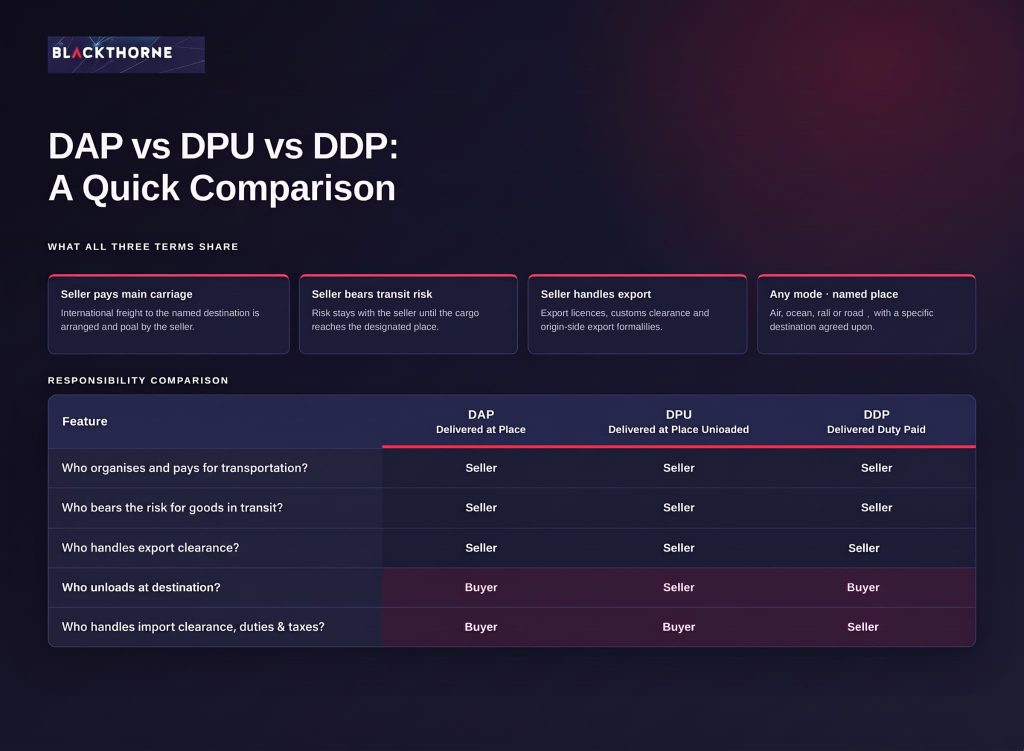
You now understand what each Incoterm looks like. Let’s now put together the distinct features of each one of them:
You can refer to the table below for a quick comparison of who handles what under DDP, DAP, and DPU.
Now that you already know the seller and buyer responsibilities for DDP, DAP, and DPU, how do you determine the best Incoterm for your specific transaction?
The best Incoterm accounts for the financial implications, legal requirements, and operational capability of the buyer and seller.
Here are the four key considerations to make when choosing an Incoterm for your business:
Import and export requirements vary from country to country. Before you agree on an Incoterm, establish whether the party expected to handle import/export clearance is legally authorised, knowledgeable, and experienced to fulfill associated obligations.
For instance, as a seller, you may prefer DDP because you want your customer to have a seamless, do-nothing-till-it-arrives experience. However, delivering that experience depends largely on the destination country’s regulations.
If the destination country is known for unpredictable tariff adjustments, abrupt regulatory changes, or bureaucratic customs procedures, handling import clearance as a foreign seller can attract avoidable costs and delays.
In such a case, the local buyer may need to handle import customs clearance under DAP. They speak the local language, understand the clearance procedures, and are hence better positioned to resolve customs issues.
You must consider the weight and type of your goods and the handling requirements for safe unloading.
For instance, if you are shipping heavy equipment to a remote construction site where the buyer lacks necessary handling equipment, you can organise and coordinate the logistics and personnel for safe unloading.
Conversely, if you deliver the same equipment to an established warehouse or factory with suitable lifting equipment and trained personnel, the buyer can unload using existing facilities.
Has any of you previously and successfully imported into the specific destination?
You want to understand who is best positioned to handle import compliance, logistics planning, and customs clearance.
For instance, if you already manufacture and supply IT equipment to the destination country and the buyer is a first-time local distributor, you may opt for DDP. That way, you utilise your existing network and knowledge to simplify the buyer’s importing experience.
Before agreeing on an Incoterm, you must consider who acts as the importer of record. Essentially, the party clearing goods through customs at the destination country is the importer of record.
While some countries allow foreign importers to act as their own IOR, you must meet specific eligibility requirements to serve in that capacity.
You don’t want to choose DDP as your Incoterm, only to realise a foreign importer cannot act as the IOR in the destination country when filing customs.
Have you ever initiated a cross-border transaction that left you regretting the decision long after fulfillment? Or paid for an overseas parcel only to receive an invoice that’s double your budget?
It happens, even to the most experienced importers/exporters. Such regrets stem from an oversight or lack of transparency in choosing an Incoterm.
You may assume that a specific Incoterm works well for you and your customers, only to realise that the destination country’s regulatory requirements dictate otherwise.
Incoterms are a straightforward way to share risks, costs, and responsibilities in any cross-border transaction.
By learning how these trade rules work, you can ask the right questions before closing any business deal, even when you are importing/exporting for the first time.
However, Incoterms do not replace local regulations.
For instance, when importing/exporting from the US, the USPPI rule determines who can act as the exporter and their specific responsibilities. That means regardless of your Incoterm, the USPPI must fulfill the stipulated responsibilities.
You can execute a compliant export transaction that doesn’t meet your profit margins. But you cannot even think about profits when your goods are stuck at customs for noncompliance.
Hence, whether DDP, DAP, or DPU, compliance comes first. Before choosing an Incoterm, consider the regulatory requirements guiding the transaction.
Looking at the responsibilities of the importer of record, you realise that compliance sits at the top throughout the international supply chain.
The Incoterm you choose largely influences who acts as the IOR, and consequently, how they fulfill import compliance. That’s why we highlighted considering the IOR when choosing an Incoterm.
For instance, under DDP, the seller is responsible for import customs clearance. But what happens when the foreign seller is ineligible to act as the IOR? That’s when a third-party IOR comes into play.
You can appoint a third-party IOR with a local presence to act on your behalf.
With a dedicated third-party IOR, you can delegate the most challenging compliance responsibilities, including:
And if you are looking for a hands-off import transaction, Blackthorne IOR can handle it all on your behalf. Our local offices in over 225 import destinations allow us to offer entity representation so you don’t have to set up a local office to import under DDP.
So, if you are looking for a third-party IOR who can represent you locally, you can email us at sales@blackthorneit.com or hit that call button so we can act on your behalf.
© 2023 Blackthorne International Transport Ltd. Registered Company Number: 7006098 | BMS Policy | Privacy Notice | Cookie Policy
